





Is Your AI Ready for the EU AI Act?
Our AI governance assessment covers the AI you build and use. You get a list of every AI system, its risks, an AI policy and the gaps against the Act, ready for your lawyer.
 WhatsApp


Why AI governance gets put off until someone asks
AI arrives one tool at a time: a chatbot here, a writing assistant there, a model inside a product. Then a customer, an investor or a regulator asks what AI you use and how you manage its risks, and nobody has the list.
-
“We do not know every AI tool our teams use.”

A model inventory lists each AI system, what it does, the data it touches and who owns it.
-
“A customer sent us an AI questionnaire and we stalled.”

A risk register and an AI policy give you written answers you can keep up to date.
-
“We are not sure whether the EU AI Act applies to us.”

Each AI use is placed against the Act's risk tiers, with the open questions for your counsel.

Every AI tool you build or buy, listed and owned
The assessment looks at the AI you build and the AI you buy. Each part below is a document you keep and update.
-
A model inventory
Every AI system in use or in development: what it does, the model and vendor behind it, the data it touches and its owner.
-
A risk register
The risks each AI use carries, such as wrong answers, data leaks or bias, with an owner and a control for each.
-
An AI policy
Plain rules for your people: which AI tools are allowed, what data may go into them and who approves new ones.
-
EU AI Act readiness
Each AI use placed against the Act's risk tiers, with the duties that may follow and the questions for your counsel.
-
ISO 42001 gaps
How your current practice compares with ISO 42001, the international standard for managing AI in a business, if you plan to work towards it.
Want to know how your AI behaves when someone tries to misuse it? See AI guardrails and red teaming
Documents your lawyer and team can act on
The assessment ends with working documents for your lawyer and team. They cover what AI you have, what could go wrong, the rules for using it and the gaps to close.
-

A model inventory
Each AI system with its purpose, model, vendor, data and owner.
-

A risk register
Each risk with its likelihood, impact, owner and control.
-

A draft AI policy
Allowed tools, data rules and approvals, ready for your review.
-

An EU AI Act readiness note
Likely risk tier per AI use and the open questions for your counsel.
-

An ISO 42001 gap list
Where your practice stands against the standard, if you want it.
-

A plan to close the gaps
What to do first, who owns it, and what we can build or fix for you.
Pilot-first
What a first readiness assessment covers
In the assessment, we list the AI your business builds and uses, assess its risks with your team, and draft the documents you need. It prepares you, and legal advice stays with your counsel.
- What the assessment covers
- A model inventory, a risk register, a draft AI policy and an EU AI Act readiness note for your business.
- What you get
- The documents to keep and update, a plan to close the gaps, and the questions to take to your counsel.
How an AI governance readiness assessment works
AI governance is how a business keeps track of the AI it builds and uses: who owns each system, what could go wrong, which rules apply and how they are followed. A readiness assessment writes that down, so you can answer customers, investors and regulators, and close the gaps.
-
Inventory
We list each AI system you build or use, with its owner.
-
Risk tier
Each one is placed against the EU AI Act's risk tiers.
-
Risks
We log what could go wrong, with a likelihood and impact.
-
Policy
We draft the rules and controls that address those risks.
-
Plan
The gaps, in order, with an owner for each.
- AI use A chatbot on your website answers customer questions from your help pages.
-
Inventory
Adds the support chatbot to the inventory, owned by the Head of Support, on a hosted model. -
Risk tier
Places it in the likely tier, transparency risk, for your counsel to confirm. - Risks A wrong answer about refunds; customer data sent to the model provider.
- Policy Tell people they are talking to an AI, and keep payment details out of the chat.
- Plan Add the notice, test answers before each release, review the register on a set schedule.
The European Commission says people should be made aware that they are interacting with a machine, for example when using chatbots.
Assessed by a team that builds and runs AI itself
We build and run AI systems ourselves, so we know how models, data and vendors fit together inside a business and where the risks sit. We assess from that experience and leave the legal calls to your lawyer.
 View our work
-
We ship live AI products
Gyanee.ai, which we built, and our own Chitra and ProvisCommerce are live on the App Store, Google Play and the web.
-
Built around your business
We assess the AI tools, vendors and products you already run, and the data they touch, instead of asking you to replace them.
-
Help after the assessment
We can build the controls the register calls for, then monitor and update the AI after launch.
-
Hours that overlap yours
We work on India Standard Time (IST): 4.5 to 5.5 hours ahead of London and 9.5 to 10.5 ahead of New York.
Ready for the questions, with legal calls left to your lawyer
The assessment prepares you for the questions customers, investors and regulators ask. Legal advice stays with your lawyer and certification with an independent assessor, and every document we hand over says so.
On every assessment
- It prepares you. Legal sign-off stays with your counsel.
- An ISO 42001 certificate comes only from an independent assessor. We help you get ready for one.
- We work only in the accounts you invite us into, with an NDA first on request.
- You own every document, to keep, share and update.
Interviews, a risk review, then a plan your team owns
Each assessment has a fixed scope covering your AI inventory, a risk register, a draft AI policy and an EU AI Act readiness note. We agree the scope and timeline at the discovery call.

The frameworks we assess your AI against
The law and standards your customers and regulators ask about, in plain terms. We map your AI against them, and against the systems the AI actually runs on.
-
Regulation
The EU AI Act, the European Union's law on AI, and its four risk tiers: unacceptable, high, transparency and minimal risk.
- EU AI Act
-
Standards
ISO/IEC 42001, the international standard for managing AI in a business, for teams working towards it.
- ISO/IEC 42001
-
Data protection
Where personal data goes when it meets an AI model, alongside the privacy rules you already follow.
-
Models and vendors
Hosted models from OpenAI and Anthropic, and open models on your own servers.
-
 OpenAI
-
 Anthropic Claude
-
 Ollama
-
-
Your AI
The AI you build into products and the AI tools your teams use.
Provis Technologies AI Integration services are phenomenal. We have been witnessing growth after the AI automation they have put into our business.

Send us the AI tools your teams use and the AI you build.
We will tell you what the assessment would cover, and what you would have at the end.




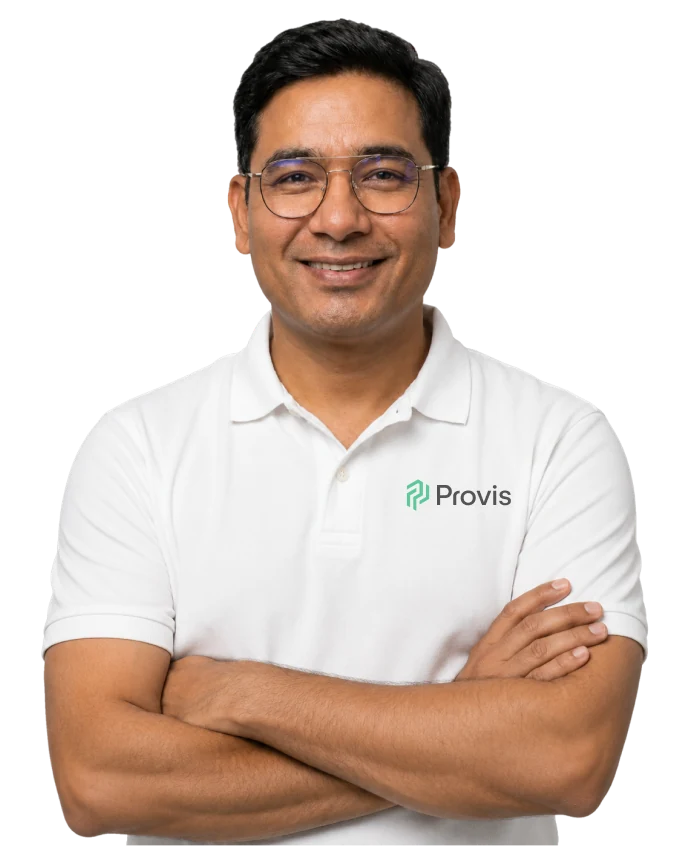
Vivek SharmaCEO & Founder, Provis Technologies
Questions about AI governance and the EU AI Act
What is AI governance consulting?

Help to keep track of the AI your business builds and uses: who owns each system, what could go wrong, which rules apply and how they are followed. Our readiness assessment turns that into a model inventory, a risk register, a draft AI policy and a plan to close the gaps.
Is this legal advice?
No. The assessment prepares you: it lists your AI, its likely risk tier and the gaps, and the questions to ask. Whether a rule applies to you, and what you must do about it, is for your counsel to decide. Legal sign-off stays with them.
Does the EU AI Act apply to my business?
That depends on what your AI does and where it is used, and your counsel makes the call. The Act sorts AI systems into four tiers: unacceptable, high, transparency and minimal risk. The assessment places each of your AI uses against them and lists the open questions.
What counts as high-risk AI?
The European Commission lists uses such as AI in recruitment, for example CV-sorting software, credit scoring, education and critical infrastructure. High-risk systems carry duties such as risk management, documentation and human oversight. The assessment flags any of your uses that may fall here.
Will you certify us for ISO 42001?
No. ISO/IEC 42001 sets out how a business should manage its AI (an AI management system), and a certificate comes only from an independent assessor. We can compare your current practice with the standard and list the gaps, so you know the gaps to close if you choose to seek certification.
What is in the assessment, and what is not?
In: a model inventory, a risk register, a draft AI policy, an EU AI Act readiness note and, if you want it, an ISO 42001 gap list, plus a handover. Not in: legal advice, a certification, or building the controls, which we can do as a separate step.
How long does the assessment take?
It depends on how many teams, products and AI vendors are in scope. We agree the scope and timeline at the discovery call, before we start, so you know when the documents will arrive.
What does a readiness assessment cost?
It depends on how much AI is in scope. Tell us which AI tools your teams use and which AI you build, and within two working days we come back with an approach, a rough timeline and a rough number. The assessment is priced up front.
What do you need from us?
An owner on your side, short interviews with the teams that use or build AI, and the vendor terms for the AI tools you pay for. We work only in the accounts you invite us into, with an NDA first on request.
Who owns the documents?
You do. The inventory, register, policy and readiness note are yours to keep, share with customers or investors, and update as your AI changes.
How is this different from AI guardrails and testing?
Governance is policy, the risk register and regulation: what you have, what could go wrong and which rules apply. Guardrails and testing are technical: checking how an AI system behaves and protecting it. The assessment may recommend tests; it does not run them.
What happens after the assessment?
You take the readiness note to your counsel and work through the plan. If the register calls for technical controls, such as an approval step, a log or answer tests, we can build them, priced up front.
Do you work with teams in the UK, EU and US?
Yes. We set calls and team interviews to fit your working day. We work only in the accounts you invite us into, with an NDA first on request, and you own every document, to keep, share and update.

Work with experts
Built for teams that need to answer for their AI
A fixed-scope readiness assessment: model inventory, risk register, AI policy and EU AI Act gaps, ready for your counsel.
Prefer to talk directly?
-
 Emailsales@provistechnologies.com
-
 WhatsApp+91 88755 82124
-
 UK phone+44 7862 126522
-
 Video callBook 30 minutes with Vivek Sharma
We're on IST: 4.5 to 5.5 hours ahead of London, 9.5 to 10.5 ahead of New York.
-
1
 Your AI
-
2
Your details
-
3
Additional info
Tell us about the AI you use
Describe the AI tools your teams use, the AI you build and why you need the assessment now.
Prefer to talk directly?
-
Emailsales@provistechnologies.com
-
WhatsApp+91 88755 82124
-
UK phone+44 7862 126522
-
Video callBook 30 minutes with Vivek Sharma
We're on IST: 4.5 to 5.5 hours ahead of London, 9.5 to 10.5 ahead of New York.