





Let Shoppers Search in Their Own Words
AI product search understands what shoppers type, finds the products that fit and shows what is in stock first. For Shopify, WooCommerce and custom stores.
 WhatsApp


Why shoppers leave your store without finding the product
Shoppers type what they want in their own words. Most store search only matches the words in your product titles, so a shopper who uses a different word sees nothing, and leaves.
-
“Shoppers search for A4 paper, and our listing says copier sheet.”

Search matches the meaning, so trade names, common names and your own descriptions find the same product.
-
“Search shows things we cannot ship.”

Results come from your live catalogue, with what is in stock shown first.
-
“We have no idea what people searched for and did not find.”

Every search that finds nothing is logged, so you see the products shoppers wanted.

Search that finds the product whatever word they use
Shoppers often use different words from your catalogue, and a big store has more products than anyone can browse. These are the search jobs we build for those stores, and where we have done them.
-
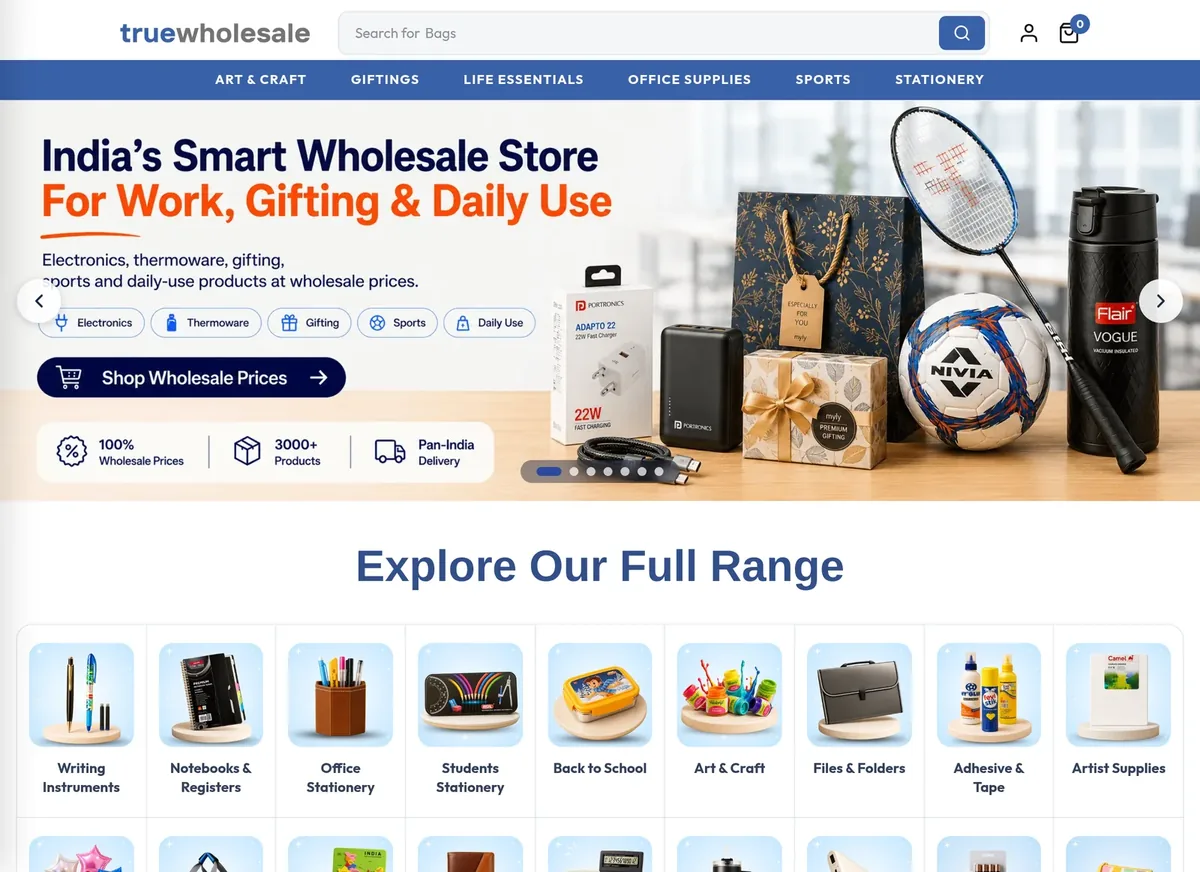
Search on your buyers' own words
Trade names, common names and warehouse descriptions all resolve to the same product, through search that knows the store's synonyms. Built on Algolia, a hosted search service, for a live wholesale store.
TrueWholesale case study -
Search by meaning for Shopify and WooCommerce
Search that matches what a shopper means against your own catalogue, on Shopify, WooCommerce or a custom store.
-
Product recommendations
Similar items and items often bought together, chosen from your catalogue and your stock, on product pages and in the cart.
-
Searches that found nothing
At TrueWholesale, the team can ask Claude, an AI assistant, which searches found nothing. Claude can read that list but cannot change anything, so the team sees what buyers looked for and did not find.
TrueWholesale case study -
Search in your shoppers' languages
Shoppers search the way they talk, such as in Hindi or Hinglish (Hindi and English mixed, typed in English letters), and still find products listed in English.
Building or running the whole store with us? See eCommerce development
Search tied to your live stock, proved on real searches
You get search and recommendations connected to your store and stock, and a set of real shopper searches that proves it finds the right products. The handover lets your team run it.
-

Search that reads meaning
Your catalogue made searchable by meaning, alongside your current search.
-

Synonyms and rules you sign off
The words your shoppers use, and the products they should find.
-

Recommendations from your catalogue
Similar items and items often bought together, from your stock.
-

Live stock and price
Results come from your store, so nothing out of stock is pushed.
-

A set of test searches
Real searches from your store with the products you expect, rerun after any change.
-

Instructions and a handover for your team
The code in your own code repository, a report of failed searches and a walkthrough.
In production
Gyanee.ai: shoppers ask in their own words and get the best deal
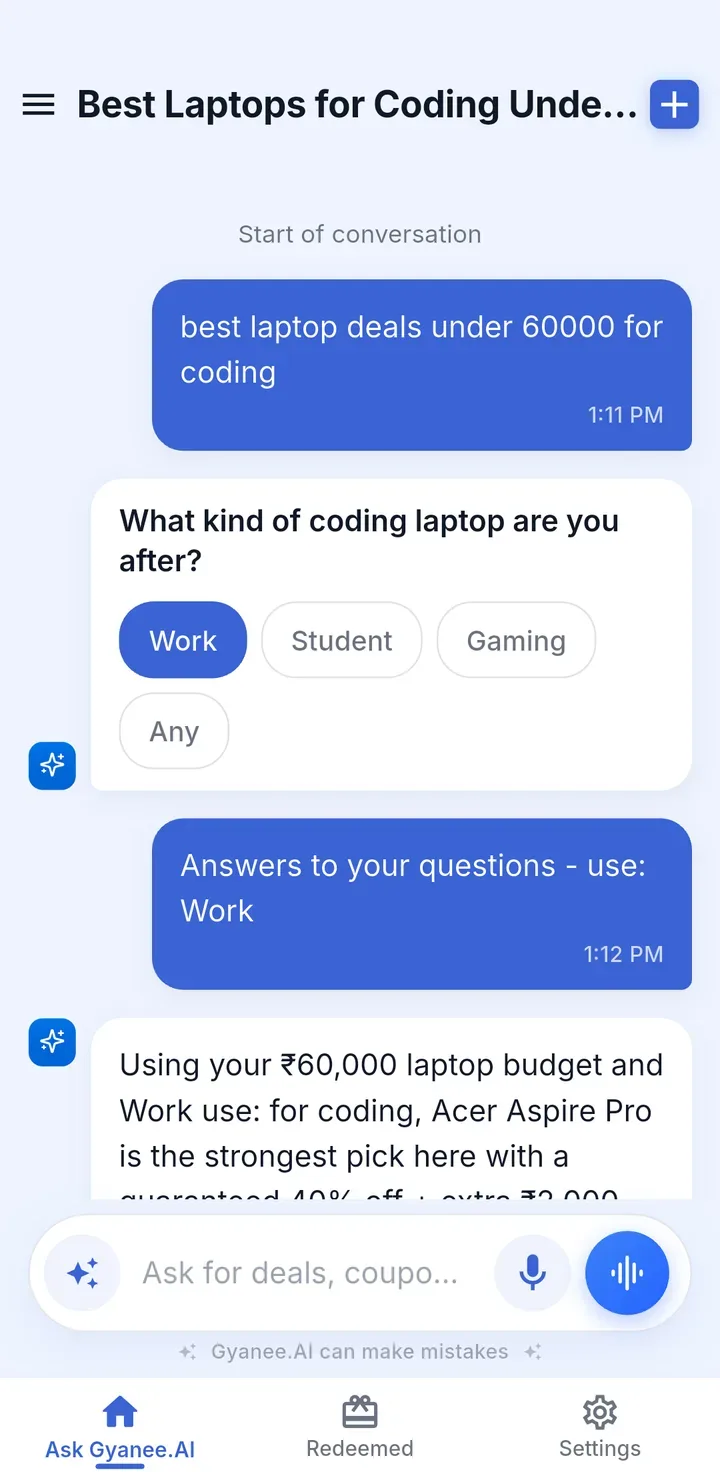
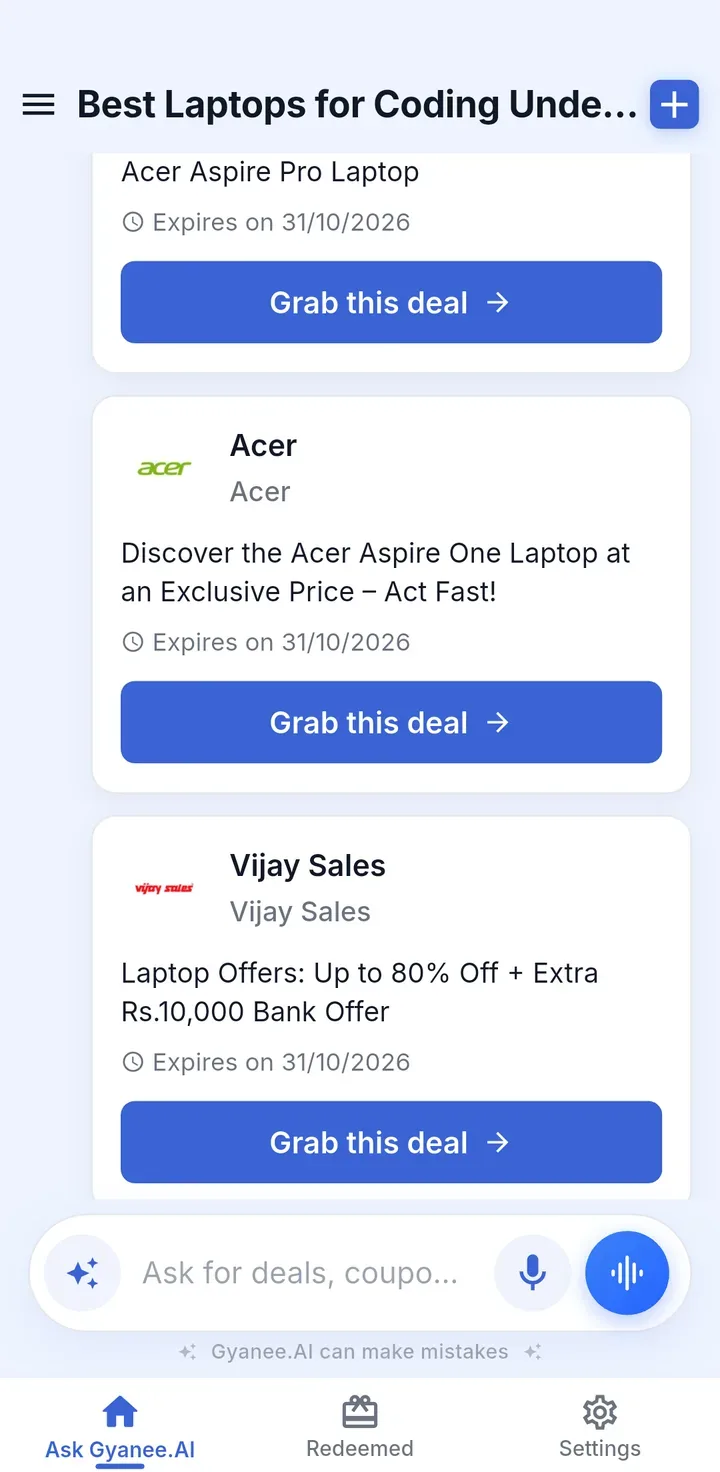
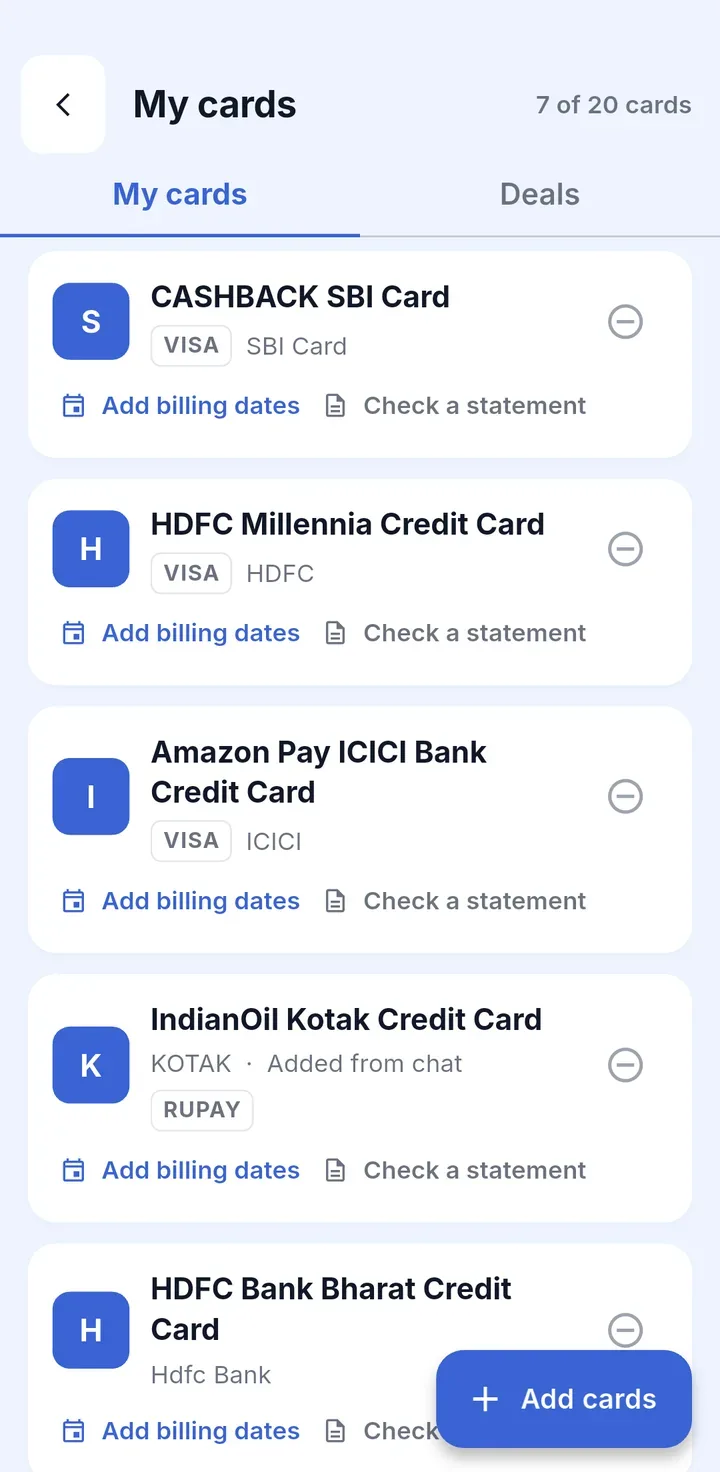
Gyanee.ai is an AI shopping assistant we built. A shopper asks by text or voice, in one of 9 languages, and it searches for deals, coupons and card offers and shows them as cards. When a question is broad, it asks a short question first. It finds deals with the same search by meaning we would build for your store.
- Built
- Search by meaning, chat and deal cards, with search by area added later.
- Checks on every answer
- A card offer shows only when the card name matches exactly, every deal's expiry date is checked each time it is read, and results from the web are marked unverified.

How AI product search works
AI product search matches what a shopper means, not only the words they type. Each product in your catalogue is stored with a description of its meaning, so a search for a warm hiking jacket finds insulated outdoor coats even when no title uses those words. Stock, price and your own rules then decide the order of the results.
-
Query
A shopper types or speaks in their own words.
-
Meaning
Search works out what they are looking for.
-
Rules
Your rules apply: stock, region, the brands you choose to show first.
-
Your catalogue
The closest products by meaning come from your live catalogue.
-
Results
The shopper sees the products that fit, and related items.
- Query “warm jacket for hiking, not too heavy”
- Meaning Search reads it as an insulated, lightweight outdoor jacket.
- Rules Only products in stock and sold in this store; the brands you choose to show first.
-
Your catalogue
Finds the in-stock products closest in meaning. -
Your catalogue
Finds the items often bought with them. - Results The best matches first, with similar items below.
A search that finds nothing is logged, so you see what shoppers wanted and did not find.
We built and run Gyanee.ai, an AI shopping assistant
We also build online stores. We add search to the store you already run, test it on your real searches and stay with you after launch.
 View our work
-
Search we have shipped
Gyanee.ai, a shopping assistant we built, is live on the App Store, Google Play and the web.
-
Built around your store
We add search to the store, catalogue and stock data you already run, instead of replacing them.
-
Support after launch
We monitor search after launch, keep it updated and improve it as new models arrive.
-
Hours that overlap yours
We work on India Standard Time (IST): 4.5 to 5.5 hours ahead of London and 9.5 to 10.5 ahead of New York.
Results shoppers can trust, from your own catalogue
Search is only useful if shoppers trust what it shows. We test it on your real searches, tie results to your live stock and leave your rules in charge of what comes first.
On every product search we build
- Results come only from your own catalogue, never from made-up products.
- Live stock and price, so nothing out of stock is pushed to the top.
- Real shopper searches tested before launch, and after every change.
- No shopper's personal details are sent to the model to answer a search.
Tested against what your shoppers actually typed
We start with your real search logs and build search on a copy of your catalogue. Each step is priced up front.

The search tools and models we build product search with
Standard, widely used tools, so another team could take the code over. We choose per store, on result quality, cost and what your platform already uses. Search can sit beside the engine you run today.
-
Search
Algolia, or PostgreSQL with pgvector for search by meaning.
- Algolia
-
 PostgreSQL
- pgvector
-
Models
OpenAI and Anthropic Claude, and open models on Ollama when data has to stay on your servers.
-
 Anthropic Claude
-
 OpenAI
-
 Ollama
-
-
Service
Python and FastAPI for the search and recommendation service.
- Python
- FastAPI
-
Stores
Shopify, WooCommerce or a custom store.
- Shopify
- WooCommerce
-
Your store
Your catalogue, stock and prices, read from the systems you already run.
Provis Technologies AI Integration services are phenomenal. We have been witnessing growth after the AI automation they have put into our business.

Send us the searches that find nothing in your store.
Tell us about your store and what shoppers search for. We will show you the searches that fail today, and how we would fix them.





Vivek SharmaCEO & Founder, Provis Technologies
Questions about AI product search
What is AI product search?

It is store search that matches what a shopper means, not only the words they type. Each product is stored with a description of its meaning, so a search finds the right products even when the shopper uses different words from your titles. Stock, price and your rules then set the order.
How is it different from keyword search?
Keyword search finds products whose titles contain the words typed, so a different word finds nothing. AI search compares meanings, so "warm jacket for hiking" finds insulated outdoor coats. The best setups use both: exact matches for product codes and brands, meaning for everything else.
Does it work with Shopify?
Yes. On Shopify we connect search to your catalogue and stock through the store's own data, and keep the index up to date as products change. It can sit beside your current search, so you can compare results before you switch over.
Does it work with WooCommerce?
Yes. On WooCommerce we index your products by meaning and serve results to your store's search box and search page, with stock and price from your store. The same approach works for a custom store built on your own database.
Can it recommend products too?
Yes. From the same index we show similar items and items often bought together, on product pages and in the cart. Recommendations come only from your catalogue and your stock, and your rules can pin or hide products.
Can shoppers search in other languages, or by voice?
Yes. Gyanee.ai, a shopping assistant we built, takes questions by text or voice in 9 languages, including Hindi and Hinglish. A store can do the same, so a shopper finds products listed in English while searching the way they talk.
Do we have to replace our current search?
No. We can add search by meaning beside the engine you run today, such as Algolia, and use it where keyword search fails. At TrueWholesale, synonym-aware Algolia search resolves trade names, common names and warehouse descriptions to the same product.
How do you know the new search is better?
We test it on real searches from your store, each with the products a shopper should find, before launch and after every change. After launch we watch the searches that find nothing, which show where the catalogue or the search needs work.
Is our data kept private?
Search needs your catalogue, not your shoppers' personal details. With hosted models from OpenAI or Anthropic, what is sent is processed by that provider. With open models on your own servers or cloud through Ollama, it stays inside your network.
How much does AI product search cost?
Three things drive the cost: the size of your catalogue, the store platform, and whether you want recommendations as well as search. Tell us about your store, and within two working days we come back with an approach, a rough timeline and a rough number.
How long does it take to build?
It depends on the catalogue and the platform. We start with the searches that fail most often today, so shoppers feel the change early. We agree the timeline at the discovery call.
Who owns the code and the search index?
You do. The code goes into your own code repository, and the cloud account and the index are in your company's name. Our team joins as collaborators, and you can remove our access at any time.
What happens after launch?
We monitor search after launch, keep it updated and improve it as new models arrive. As your catalogue grows, we add new synonyms and test searches, so results stay right for new products.

Work with experts
Built for stores whose shoppers cannot find what they want
We build product search that understands what shoppers mean, on the store you already run.
Prefer to talk directly?
-
 Emailsales@provistechnologies.com
-
 WhatsApp+91 88755 82124
-
 UK phone+44 7862 126522
-
 Video callBook 30 minutes with Vivek Sharma
We're on IST: 4.5 to 5.5 hours ahead of London, 9.5 to 10.5 ahead of New York.
-
1
 Your store
-
2
Your details
-
3
Additional info
Tell us about your store's search
Describe your store, the platform it runs on, and the searches that fail today.
Prefer to talk directly?
-
Emailsales@provistechnologies.com
-
WhatsApp+91 88755 82124
-
UK phone+44 7862 126522
-
Video callBook 30 minutes with Vivek Sharma
We're on IST: 4.5 to 5.5 hours ahead of London, 9.5 to 10.5 ahead of New York.