





Teach an AI Model Your Format, Labels and Style
With LLM fine-tuning, we train a model on your own examples, after testing how far better instructions and document search get you. A tuned model ships only when it does better.
 WhatsApp


Why prompting alone is sometimes not enough
Good prompts (the instructions you give the AI) are often all a task needs, and we start there. Fine-tuning pays off when the model still misses a format, when the examples are too sensitive to send with every request, or when a big model is too costly for the volume.
-
“It still won't answer in our format, however we word the prompt.”

A model fine-tuned on your examples learns the format, so you stop repeating it in every prompt.
-
“Our examples are sensitive, so we can't paste them into every request.”

Fine-tuning trains on them once, on an open model (an AI model you download and run yourself, such as Llama) on your own servers.
-
“The big model works, but it costs too much at our volume.”

A smaller model fine-tuned for one task can do that task where a large one costs more than it is worth.

Jobs a tuned model does better, and one it does not
Fine-tuning teaches a model how to do a task, while facts that change are better kept in your documents. These jobs suit it, and for the last one we suggest RAG (the AI looks up your documents before it answers) instead.
-
Consistent format and labels
Sorting tickets, tagging records or filling a fixed format the same way every time.
-
Your house style
Replies, summaries or product text in your tone, without a page of style rules in every prompt.
-
A smaller model for one task
A small open model trained for one job, where a large model is more than the task needs.
-
Training on data that must stay inside
An open model fine-tuned and run on your own servers, so the training data never leaves them.
-
When RAG is the better choice
If the problem is facts that change, such as prices, policies or stock, searching your documents beats training them in.
Need the model to answer from your documents instead? See RAG development
A tuned model, compared side by side with simpler options
You get a training set made from your examples, a test set the model never sees in training, the fine-tuned model, and a report that compares it with the simpler options.
-

A training set
Your examples, cleaned and checked, with real inputs and the right outputs.
-

A test set
Examples kept back from training, so the model is measured fairly.
-

A fine-tuned model
An open model such as Llama, trained with a small add-on so the original model stays as it was.
-

A comparison report
The tuned model against the model as it comes, before training (the base model), with good prompts, and against RAG where it applies.
-

Deployment you control
The model run on your own servers, or wherever your data is allowed to go.
-

A handover
The training code, the data steps and the documentation, in your own code repository.
Pilot-first
What a first fine-tuning pilot builds
Pilot-first: we start with a small pilot on your own data, priced up front, before any full build. The pilot measures how far good prompts and RAG get first, and we fine-tune only if the results say it will help.
- What the pilot builds
- A test set from your examples, a score to beat with good prompts and RAG, and a first fine-tuned open model to compare with it.
- What you get
- The comparison on your own examples, and a plain answer: fine-tune, or keep prompting and RAG.
How LLM fine-tuning works
Fine-tuning trains an existing model further on your own examples, so it learns a task, a format or a style. We train a small add-on to the model rather than the whole model, which keeps training cheaper. The tuned model is tested against prompting and RAG before it ships.
-
Examples
Real inputs with the right outputs, from your own work.
-
Baseline
How well the base model does with good prompts, and RAG where it applies.
-
Training
An open model is fine-tuned on the training examples.
-
Evaluation
It is scored on the test set, which it never trained on.
-
Decision
It ships only if it beats the score to beat.
- Examples Past tickets, each with the label your team gave it, split into a training set and a test set.
- Baseline The base model, before any training, labels the test-set tickets with a careful prompt. Its result is the score to beat.
-
Training
Trains a small add-on for a Llama model on the training tickets. - Evaluation The tuned model labels the same test-set tickets, which it never saw in training.
- Evaluation Its result is scored on the test set, next to the score to beat.
- Decision It beats the score, so it goes live on your own servers.
Had it scored lower, you would keep the prompt and save the cost of training and running a tuned model.
We only fine-tune when it beats the simpler options
We test every model on your own examples, ship a tuned one only when it wins, and run it where your data is allowed to go.
 View our work
-
Any model, your choice
We choose OpenAI, Anthropic or open models on your own servers per task, on answer quality, cost and where your data is allowed to go.
-
We test before we ship
In Gyanee.ai, an AI product we built, test sets score its answers before a change ships. Your model gets the same.
-
Support after launch
We monitor the model after launch, keep it updated and retrain it as your examples grow.
-
Hours that overlap yours
We work on India Standard Time (IST): 4.5 to 5.5 hours ahead of London and 9.5 to 10.5 ahead of New York.
Tested on examples the model has never seen
A tuned model can look good on the examples it learned from and still fail on new ones. So we test it on examples it has never seen, compare it with the simpler options, and keep your training data where you decide.
On every model we fine-tune
- The test set is kept apart and never used in training.
- The tuned model is compared with prompting before it ships.
- The test set runs again before each new version.
- Your training data stays where you decide, on your servers if needed.
Good prompts and RAG get measured before any training
We first measure how far good prompts and RAG get on your examples, fine-tune only where they fall short, and ship the model that wins. Each step is priced up front, and you can stop after the pilot.
The models and tools we fine-tune with
Standard, widely used tools, so another team could take the code over. We fine-tune open models you can own and run yourselves, and serve them where your data is allowed to go.
-
Base models
Open models such as Llama, Qwen, Gemma and Mistral, chosen for the task.
- Llama
- Qwen
- Gemma
- Mistral
-
Training
Small add-on training on the open model, in Python.
- Python
-
Serving
The tuned model run with Ollama on your servers, or in your own cloud.
-
 Ollama
-
-
Hosting
Your own servers, or a cloud account in your company's name.
- Your servers
-
Your data
The examples the model learns from, and the documents RAG can search instead.
Provis Technologies AI Integration services are phenomenal. We have been witnessing growth after the AI automation they have put into our business.

Send us the task you want a model to learn.
Tell us what examples you have and what the model gets wrong today. We will tell you honestly whether fine-tuning, prompting or RAG is the right first step.



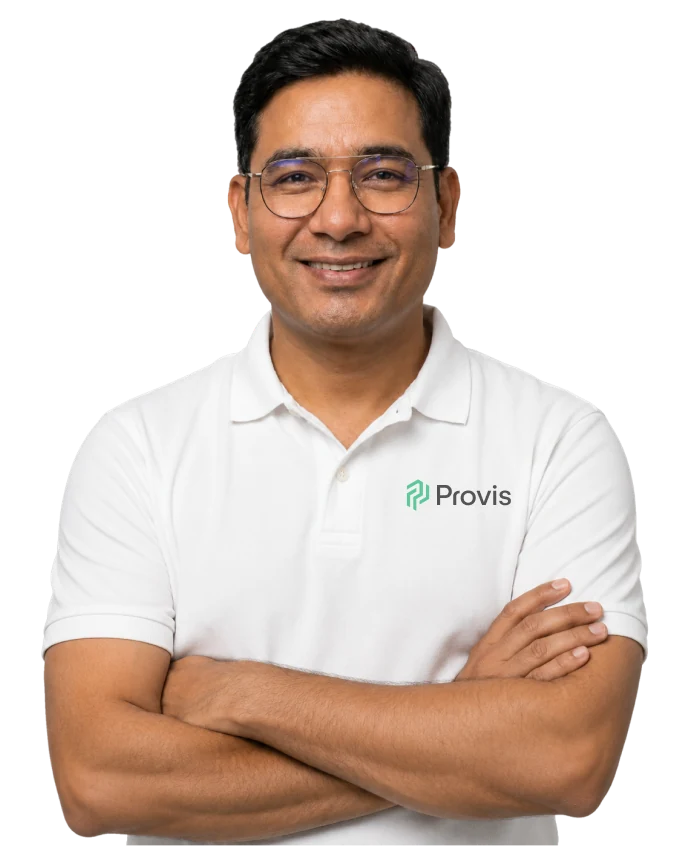
Vivek SharmaCEO & Founder, Provis Technologies
Questions about LLM fine-tuning
What is LLM fine-tuning?

Training an existing large language model (LLM) further on your own examples, so it learns a task, a format or a style. With adapter methods such as LoRA, only a small set of added weights is trained and the original model stays unchanged. The result is a model that does your task without long instructions in every prompt.
Fine-tuning or RAG: which do we need?
Use RAG when the answers depend on facts that change or must be cited, such as prices, policies or stock. With RAG, the model searches your documents at the moment of the question. Use fine-tuning when the model must learn a way of working, such as a format, labels or a style. Our RAG development page covers the first.
When is fine-tuning not worth it?
When good prompts already do the job, which is often; OpenAI's own guide says prompt engineering may be all you need. Also when your facts change often, since RAG keeps them current, or when you have only a handful of examples. We measure prompting and RAG first, so you only pay to fine-tune when it helps.
Can you fine-tune Llama and other open models?
Yes. We fine-tune open models such as Llama, Qwen, Gemma and Mistral, then run the tuned model on your own servers or in your cloud. Open models also mean you can keep the tuned model files (the weights) and move them, within the base model's licence.
How many examples do we need?
It depends on the task, and quality matters more than quantity: consistent, correct examples beat a large messy set. In the pilot we hold some of your examples back to test the model, so the results show whether you have enough before you invest in more.
Does our training data stay private?
If you choose an open model on your own servers, the training data and the tuned model stay on machines you control. If you fine-tune a hosted model, such as one from OpenAI, the provider processes the data. We help you choose based on your rules.
Can you fine-tune OpenAI models too?
Yes, where OpenAI offers fine-tuning for the model you need. It can let a smaller, cheaper model handle a task a larger one did. The data is then processed by OpenAI, and the model runs on its service, so it is a choice for data that is allowed to go there.
Will a fine-tuned model know our latest prices or products?
No. A model learns from the examples it was trained on, and does not see later changes unless you retrain it. For facts that change, such as prices, stock or policies, RAG is the right tool, and the two can work together: a tuned model answering from documents that RAG finds.
How do you know the tuned model is better?
We test it on the test set, examples it never trained on, and score it next to the base model with good prompts, and next to RAG where it applies. It ships only if it wins on the measure we agreed at the start. If it does not, we tell you and you keep the simpler option.
How much does LLM fine-tuning cost?
Three things drive the cost: how ready your examples are, the size of the model, and where it will run. Tell us the task and what examples you have, and within two working days we come back with an approach, a rough timeline and a rough number.
How long does it take?
It depends on how ready your examples are and how many rounds of training the task needs. We start by setting the score to beat and running a pilot fine-tune, so you see the comparison before a full project. We agree the timeline at the discovery call.
Who owns the fine-tuned model?
You do. The tuned weights, the training code, the data steps and the documentation go to you, in your own code repository and on your machines, within the licence of the base model you chose. You can retrain or run it yourselves.
Do you work with UK and US clients from India?
Yes. We sign an NDA before we start, on request, and work only in the accounts you invite us into. The code goes into your own code repository, in an account in your company's name.

Work with experts
Built for teams whose AI must learn their way of working
We fine-tune open models on your examples and ship one only when it beats prompting and RAG on your own tests.
Prefer to talk directly?
-
 Emailsales@provistechnologies.com
-
 WhatsApp+91 88755 82124
-
 UK phone+44 7862 126522
-
 Video callBook 30 minutes with Vivek Sharma
We're on IST: 4.5 to 5.5 hours ahead of London, 9.5 to 10.5 ahead of New York.
-
1
 The task
-
2
Your details
-
3
Additional info
Tell us the task you want a model to learn
Describe the task, the examples you have, what the model gets wrong today and where the data may go.
Prefer to talk directly?
-
Emailsales@provistechnologies.com
-
WhatsApp+91 88755 82124
-
UK phone+44 7862 126522
-
Video callBook 30 minutes with Vivek Sharma
We're on IST: 4.5 to 5.5 hours ahead of London, 9.5 to 10.5 ahead of New York.