





Let Claude and ChatGPT Answer From Your Own Data
An MCP server gives AI apps one standard way to read your store, CRM or database, through tools we build for you. We start read-only, and private fields stay out.
 WhatsApp


Why your AI app cannot answer business questions yet
Your data sits in your store, CRM or database. The AI app your team uses cannot see it, so questions still wait for whoever can run a report. An MCP server gives the AI app a set of tools to read that data, and nothing more.
-
“Every simple question turns into a spreadsheet export.”

Claude asks the server's tools and answers from your live data, in plain English.
-
“We want AI on our data, but not access to everything.”

The server offers only the tools you sign off, and fields such as phone numbers and emails can stay out.
-
“Each AI app would need its own integration.”

One MCP server works with any AI app that supports MCP, such as Claude and ChatGPT.

Claude and ChatGPT reading the systems you already run
Build one when your team keeps asking questions only your systems can answer. Here are the servers we build, and where we have done it.
-
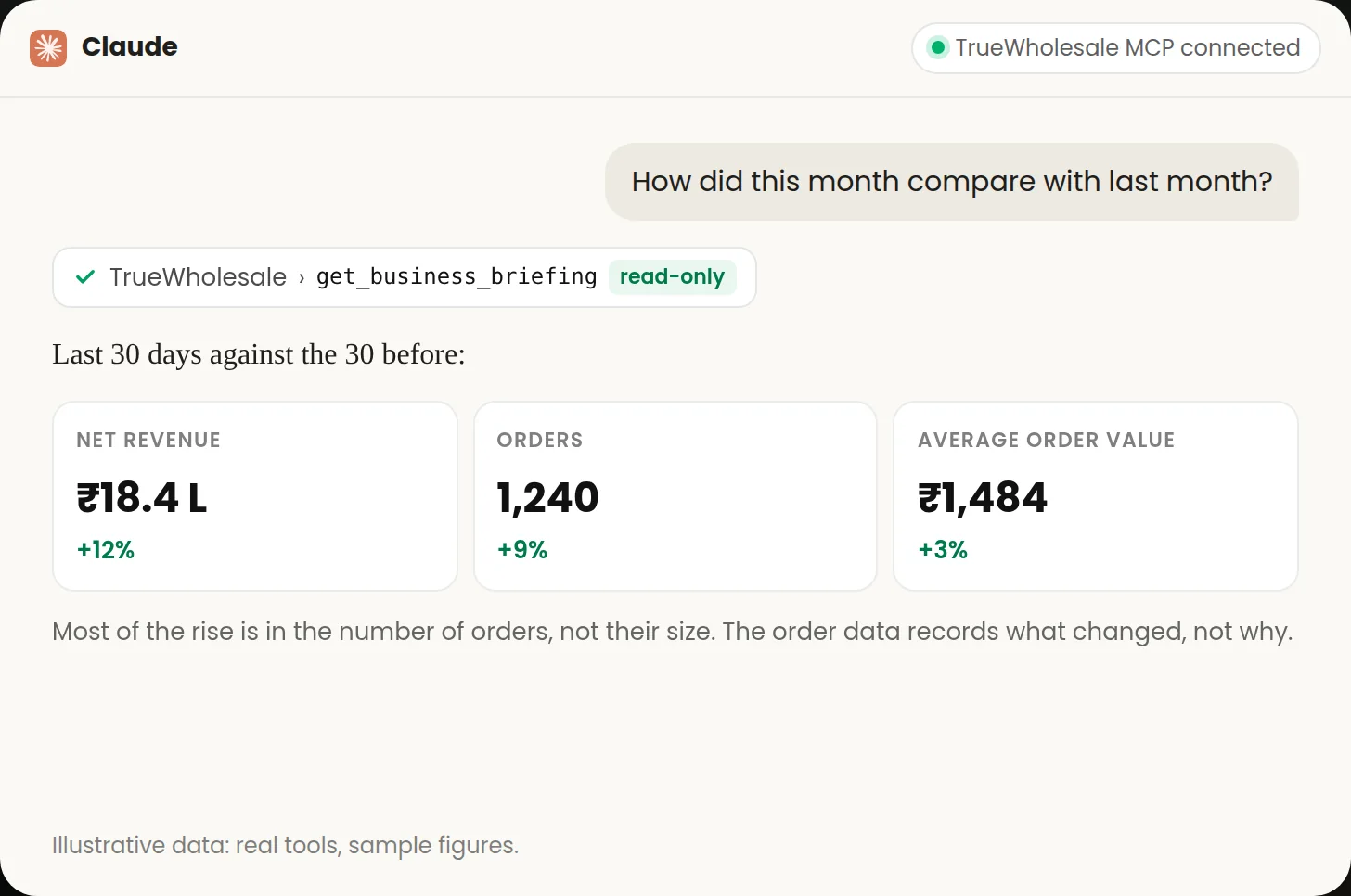
Business questions over your store data
Your team asks about sales, stock, customers and app activity, and the AI app reads the answer from your platform.
TrueWholesale MCP server -
Head office questions across your sellers
Head office asks Claude about one seller's data, kept separate from every other seller's.
ProvisCommerce MCP server (in development) -
Claude or ChatGPT on your database
Read-only queries your team can run in plain English, limited to the tables and fields you choose.
-
Your product inside your customers' AI apps
A server for your software product, so your users can ask Claude or ChatGPT about their own account data after they sign in.
-
Internal tools your team already uses
Your helpdesk, CRM or project tracker, read through one server instead of an export per tool.
Building an AI agent on top of the server? See AI agent development
Read tools you sign off, plus the tests that prove them
You get a working MCP server connected to your systems and a written list of what each tool may read. Tests prove it answers correctly, and a handover lets your team run it.
-

An MCP server with read tools
Each tool answers one kind of question from your systems.
-

A tool list you sign off
What each tool reads, what it leaves out, and who may use it.
-

Data rules in the server
Fields you keep private never leave your system, whoever asks.
-

Sign-in and access by role
Each person sees only what their role allows.
-

A set of test questions
Real questions from your business with the answers you expect, rerun after any change.
-

Instructions and a handover for your team
The code in your own code repository, the documentation and a walkthrough.
In production
TrueWholesale: Claude on a live ordering platform
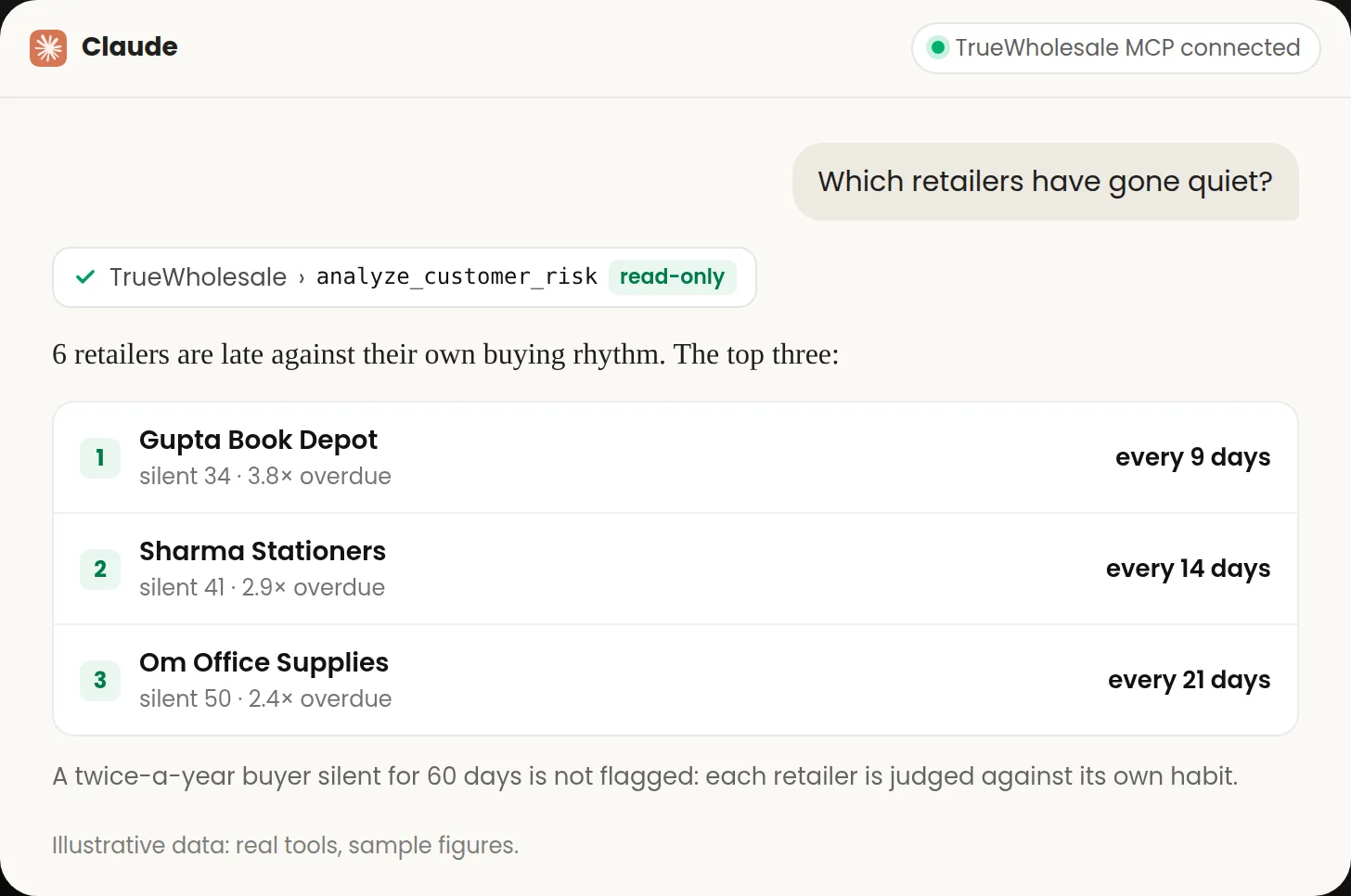
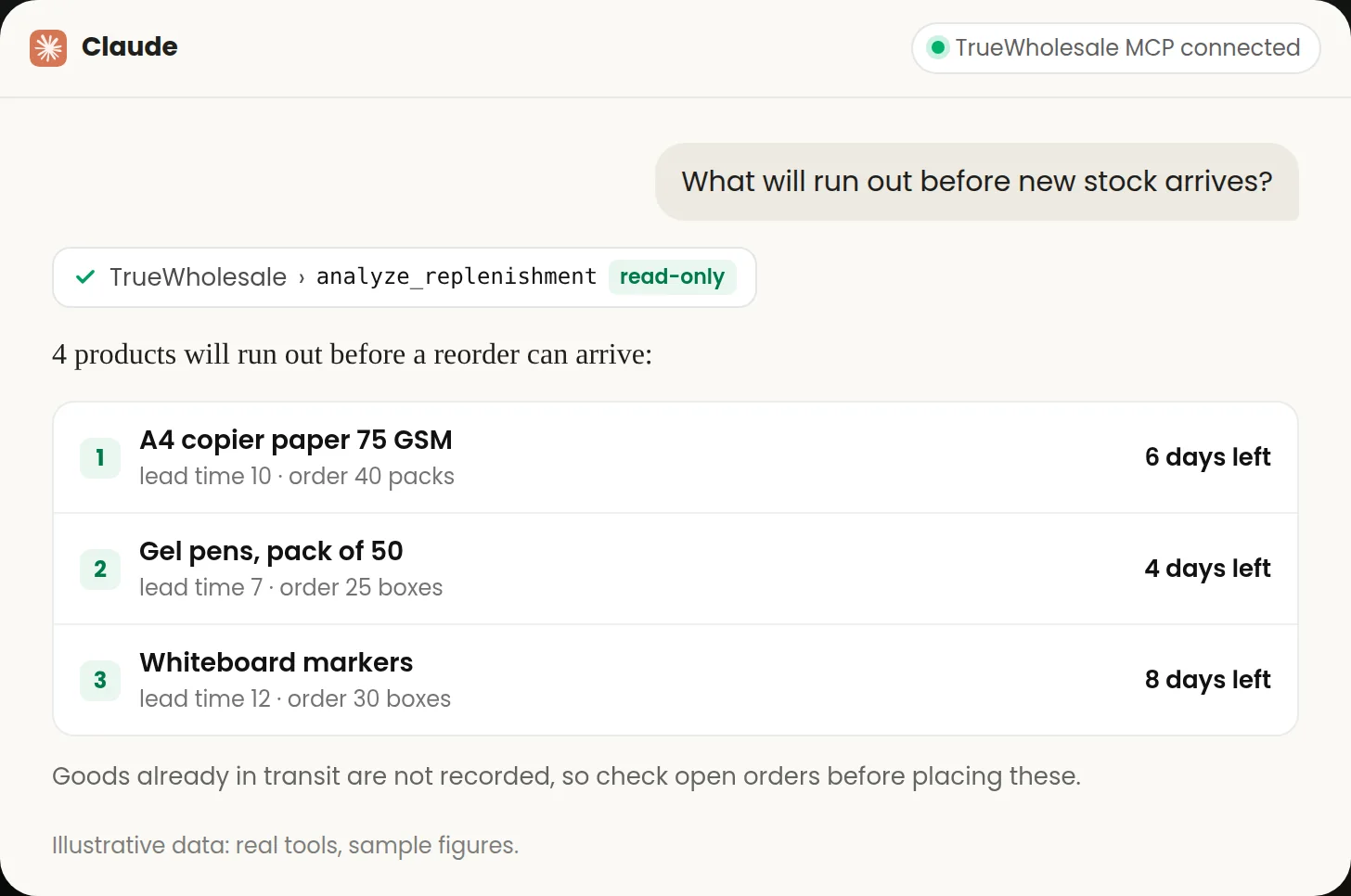
TrueWholesale sells stationery and office supplies to retailers across India. We connected Claude to its live ordering platform through an MCP server with 6 read-only tools and 2 live data sources, and made no changes to the platform. The team asks in plain English, and Claude reads the orders, stock and app activity the platform already records.
- Built
- Six read-only tools: a business briefing, customer risk, replenishment, app behaviour, customer activity and sales.
- Rules in the data
- No phone or email is shared with Claude. Items left in carts are kept out of sales figures, because they are not yet sales.

How an MCP server works
An MCP server is a small service that sits between an AI app, such as Claude or ChatGPT, and your systems. It offers a set of tools, each one a question your data can answer, and checks every request before it reads anything. MCP, the Model Context Protocol, is the open standard that lets AI apps use those tools.
-
Question
A person asks in the AI app they already use.
-
Tool choice
The AI app picks a tool from the list your server offers.
-
Checks
The server checks who is asking and what they may see.
-
Your systems
The tool reads your store, CRM or database, and leaves private fields out.
-
Answer
The AI app writes the answer from what the tool returned.
- Question “Which customers have stopped ordering lately?”
- Tool choice Claude reads the server's tool list and picks the one that answers it.
- Checks The person is signed in, and their role may use this tool.
-
Your systems
Finds the customers who are late against their own ordering habit -
Your systems
Fetches their last orders, with no phone or email - Answer “These customers are late against their usual rhythm. Here are their last orders.”
- Answer Claude offers to send them a reminder. The server has no tool that writes, so it cannot.
Had you wanted reminders sent, we would add a write tool that asks a person to approve each one.
We already connected Claude to a live ordering platform
We build MCP servers the way we built TrueWholesale's, read-only first and on the systems you already run. We are still there after launch.
 View our work
-
A live MCP server behind us
TrueWholesale's team asks Claude about its own platform through six read-only tools we built.
-
Built around your systems
We connect the server to the store, CRM or database you already run, instead of replacing them.
-
Support after launch
We monitor the server after launch, keep it updated and improve it as new models arrive.
-
Hours that overlap yours
We work on India Standard Time (IST): 4.5 to 5.5 hours ahead of London and 9.5 to 10.5 ahead of New York.
Private fields stay out, whoever asks the AI app
An MCP server is only useful if you can trust what it shares. We decide with you what each tool may read and keep private fields out, and a tool that writes comes only if you ask for one.
On every MCP server we build
- Read tools first; a write tool only with your say-so, and a person approves each write.
- Private fields, such as phone numbers and emails, never leave the server.
- Each person signs in and uses only the tools their role allows.
- A log of every tool call, with usage limits.
Read-only first, more tools once the first ones prove out
We start with the questions your team asks most and build the read tools that answer them. More tools follow once those have proved themselves, and each step is priced up front.

The AI apps and tools we build MCP servers with
Standard, widely used tools, so another team could take the code over. One server works with every AI app that supports MCP, so you are not tied to one. We build it on your systems, in your cloud, with the tools below.
-
AI apps
Claude and ChatGPT, and tools such as Visual Studio Code and Cursor.
-
 Anthropic Claude
-
 ChatGPT
- VS Code
- Cursor
-
-
Server
Python and FastAPI, on the Model Context Protocol.
- Python
- FastAPI
-
Models
OpenAI and Anthropic Claude, and open models on Ollama when data has to stay on your servers.
-
Anthropic Claude
-
OpenAI
-
 Ollama
-
-
Hosting
Your own cloud account, such as AWS, in your company's name.
- AWS
-
Your systems
Your store, CRM, helpdesk, ERP or database, through tools we build for them.
Provis Technologies AI Integration services are phenomenal. We have been witnessing growth after the AI automation they have put into our business.

Name the questions you want Claude to answer from your data.
Tell us the questions your team asks and where the answers live. We will show you the tools we would build, and what to keep out.





Vivek SharmaCEO & Founder, Provis Technologies
Questions about MCP server development
What is an MCP server?

A small service that lets an AI app such as Claude or ChatGPT use your systems through tools you define. MCP, the Model Context Protocol, is an open standard created at Anthropic; its own site calls it a USB-C port for AI applications. The AI app sees which tools exist, calls them, and answers from what they return.
How is an MCP server different from a REST API?
A REST API is a way for other software to connect to your system. It serves programs that already know how to call it, so each AI app would need its own integration. An MCP server describes its tools in a standard form any MCP-aware AI app can find and call, so one server serves several apps. It usually sits on top of your existing API or database rather than replacing it.
Do I need a custom MCP server, or is there an existing one for my system?
If a well-known tool already offers an MCP server and it reads what you need, use it. You need a custom server when the data is your own, your rules decide what may be shared, or the questions cross systems, as at TrueWholesale, where one server reads the store and a record of what people do in the app.
Which AI apps can use the server?
Claude and ChatGPT both support MCP, and so do developer tools such as Visual Studio Code and Cursor. In the Claude apps and in ChatGPT, you add a remote server by its URL. We test the server in the apps your team actually uses before launch.
Can you make it read-only?
Yes, and that is where we start. Our live server at TrueWholesale has six tools, all read-only, and it made no changes to the platform. A read-only server has no tool that writes at all, rather than a write tool marked as safe.
How do you stop personal data from reaching the AI?
The server leaves those fields out before anything reaches the AI app, whoever asks. At TrueWholesale, no phone or email is shared with Claude. Remember that what a tool returns is processed by the model's provider, so we keep tool results to what the answer needs.
How do users sign in, and can we limit who has access?
Each person can sign in with their usual work login (OAuth), or an organisation owner can set one shared credential. We map roles to tools, so each person uses only the tools their job needs, and you can remove anyone's access at any time.
Where will our MCP server run?
Usually as a remote server in your own cloud account, in your company's name, next to the systems it reads, so Claude and ChatGPT can reach it over the internet behind sign-in. A local server on one computer also works for a single user in the Claude desktop app.
Can it connect to our database or ordering system directly?
Yes. We build read tools for the tables and fields you choose, each answering a known kind of question, so answers are tested and private columns stay out. At TrueWholesale we connected Claude to the live ordering platform with no changes to the platform.
How much does MCP server development cost?
Three things drive the cost: how many systems the server reads, how many tools it needs, and whether any tool writes. Tell us the questions your team asks, and within two working days we come back with an approach, a rough timeline and a rough number.
How long does it take to build?
It depends on the systems and the number of tools. We start with the few tools that answer your most common questions, so your team uses them before we build more. We agree the timeline at the discovery call.
What happens after launch, and can we add tools later?
We monitor the server, keep it updated and add tools as your questions change, each one signed off like the first. You own the code, which sits in your own code repository, so your team can also run and extend it yourselves.
Can you add write actions, such as placing an order, later?
Yes, when you are ready. We can add a write tool that does one narrow job and asks a person to approve each run; ChatGPT also asks for confirmation before a write action. Your read tools keep working as they are.
Do you work with UK and US clients from India?
Yes. We sign an NDA before we start, on request, and work only in the accounts you invite us into. The code repository, cloud account and domain stay in your company's name, and you can remove our access at any time.

Work with experts
Built for teams that want answers from their own data
We build MCP servers that let Claude and ChatGPT read your systems through tools you define, read-only first.
Prefer to talk directly?
-
 Emailsales@provistechnologies.com
-
 WhatsApp+91 88755 82124
-
 UK phone+44 7862 126522
-
 Video callBook 30 minutes with Vivek Sharma
We're on IST: 4.5 to 5.5 hours ahead of London, 9.5 to 10.5 ahead of New York.
-
1
 The server
-
2
Your details
-
3
Additional info
Tell us what you want the AI app to read
Describe the questions your team asks, the systems that hold the answers, and anything that must stay private.
Prefer to talk directly?
-
Emailsales@provistechnologies.com
-
WhatsApp+91 88755 82124
-
UK phone+44 7862 126522
-
Video callBook 30 minutes with Vivek Sharma
We're on IST: 4.5 to 5.5 hours ahead of London, 9.5 to 10.5 ahead of New York.