





Ask Your Data a Question. Get an Answer You Can Check.
Conversational BI (business intelligence you can ask in plain English) is a data assistant that answers from your own database. It reads only the tables you allow and shows the query behind every answer.
 WhatsApp


Why simple data questions still wait in a queue
The answer is already in your database. But only someone who knows SQL (the language databases use) and the table names can get it out, so a quick question becomes a ticket, and the dashboard never has quite the view you need.
-
“Every simple question turns into a ticket for the data team.”

Your team asks in plain English and gets the answer from your database in the chat.
-
“We can't give everyone access to the database.”

The data assistant uses a read-only account that sees only the tables and columns you allow.
-
“Two people ask the same question and get two numbers.”

Terms such as revenue or active customer are defined once, so the same question gives the same answer.

Answers without waiting for whoever writes the queries
These questions usually wait for whoever can query the database. The data assistant answers them, and the first item is the closest work we have live.
-
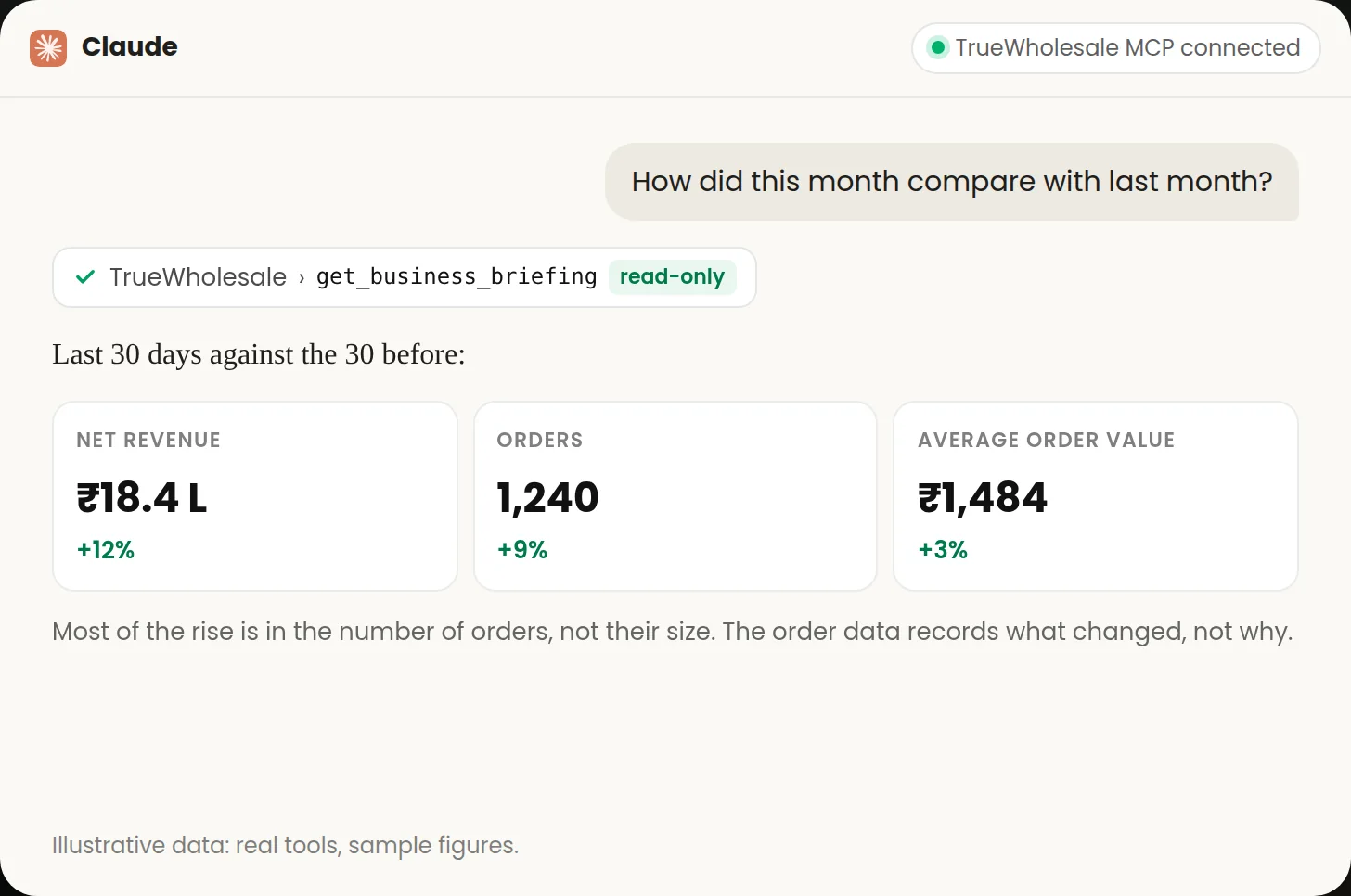
Business questions over your platform data
At TrueWholesale, the team asks in plain English and Claude reads the same orders, stock and app activity the platform already records, through 6 read-only tools we built. The tools answer set questions and write no SQL.
TrueWholesale case study -
Sales and order questions
Ask for best sellers by region, late orders or average order value, and get the answer from your own tables with the query shown.
-
One meaning for each business term
Revenue, margin and active customer are defined once, so the data assistant and your reports agree.
-
Claude or ChatGPT on your database
Your team asks the same questions in Claude, ChatGPT or a chat inside your own app. For Claude and ChatGPT, an MCP server (a standard way to plug AI apps into your systems) gives them read-only access.
See MCP server development -
Read-only access to a copy
Queries run on a read-only account, ideally on a copy of your database kept in sync, so your live system stays fast and unchanged.
Need a forecast of what comes next? See predictive analytics
A data assistant that shows the query behind each answer
You get a data assistant that answers from your database and the definitions it works from. A test set of real questions shows it answers correctly, and instructions let your team run it.
-

The data assistant
It turns plain-English questions into read-only queries and shows the query with each answer.
-

A data dictionary you sign off
Which tables and columns it may read, and what each business term means.
-

A read-only database account
It reads what you allow and has no permission to change anything.
-

Sign-in and access by role
Each person sees only the data their role allows.
-

A test set of real questions
Your questions with the answers you expect, rerun after every change.
-

Instructions and a handover for your team
The code in your own code repository, the documentation and a walkthrough.
Pilot-first
A first pilot: your team's questions, answered from one database
Pilot-first: we start with a small pilot on your own data, priced up front, before any full build. The pilot takes the questions your team asks most, connects a read-only account to one database, and tests the answers against the ones you expect before anyone relies on them.
- What the pilot builds
- A data assistant on one database, read-only, with a data dictionary for the tables it may use.
- What you get
- The test set and how it scored, the queries it wrote, and a plan for the rest of your data.
How text-to-SQL works
Text-to-SQL turns a question in plain English into a database query, runs it with read-only access, and returns the answer with the query that produced it. Conversational BI puts that in Claude, ChatGPT or a chat inside your own app, so a question about orders or customers gets answered without a ticket to an analyst.
-
Question
A person asks in plain English.
-
Meaning
Business terms are matched to the definitions you signed off.
-
Checks
The data assistant checks who is asking and what they may see.
-
Your database
One read-only query runs on the tables you allow.
-
Answer
The answer comes back with the query behind it.
- Question “Which products sell best in the north region?”
- Meaning “Sell best” is units sold; “north” is the region column, as your dictionary defines them.
- Checks The person is signed in, and their role may read sales data.
-
Your database
Adds up units sold per product in the north region, from the order lines table. -
Your database
Reads through the read-only account, from allowed tables only. Customer phone numbers and emails stay out. - Answer “These products sold the most units in the north. Here is the query.”
Asked to update a price, it cannot: the account it uses can only read.
Plain-English answers already live on a client's platform
A client's team already asks Claude about its own platform data in plain English, read-only. We build on the database you already run.
 View our work
-
Plain-English answers, live
TrueWholesale's team asks Claude about its own platform through six read-only tools we built.
-
Built around your systems
We connect the data assistant to the database and dashboards you already run, instead of replacing them.
-
Support after launch
We monitor the data assistant after launch, add tables and refine definitions as your questions change, and update it as new models arrive.
-
Hours that overlap yours
We work on India Standard Time (IST): 4.5 to 5.5 hours ahead of London and 9.5 to 10.5 ahead of New York.
Numbers you can check, from a database it cannot change
A data assistant that writes queries has to be harmless, and its numbers easy to check. We limit what it can read, show every query, and test it against answers you already know.
On every conversational BI system we build
- A read-only database account, so your data stays as it is.
- Access to the tables and columns you allow, with private fields left out.
- The query shown with every answer, so anyone can check it.
- A record of every question and query, with limits on how much it can be used.
One database and a pilot before your team relies on it
We start with the questions your team asks most and one database, and prove the answers on a pilot. We widen it once those answers hold, and each step is priced up front.

The models and tools we build conversational BI with
Standard, widely used tools, so another team could take the code over. We build on your database and in your own cloud account, with the AI model that suits your data.
-
Where people ask
Claude and ChatGPT through an MCP server, or a chat inside your own app.
-
 Anthropic Claude
-
 ChatGPT
-
-
Models
OpenAI and Anthropic models, and open models on Ollama when data has to stay on your servers.
-
OpenAI
-
Anthropic Claude
-
 Ollama
-
-
Service
Python and FastAPI, in your own cloud account, such as AWS.
- Python
- FastAPI
- AWS
-
Your database
PostgreSQL or the database you already run, through a read-only account.
-
 PostgreSQL
-
Provis Technologies AI Integration services are phenomenal. We have been witnessing growth after the AI automation they have put into our business.

Send us the questions your team keeps asking.
Tell us where the data lives and what must stay private. We will show you what a pilot would answer, and what to keep out.




Vivek SharmaCEO & Founder, Provis Technologies
Questions about text-to-SQL and conversational BI
What is text-to-SQL?

Text-to-SQL turns a question in plain English, such as which products sell best in a region, into a SQL query on your database. The query runs with read-only access, and the answer comes back with the query that produced it, so anyone who knows SQL can check it.
What is conversational BI?
Conversational BI puts text-to-SQL in a chat. Your team asks about your existing data in Claude, ChatGPT or a chat inside your own app, and gets numbers back without waiting for a report. It answers questions about what has already happened. Forecasting what comes next is a separate service.
How is this different from our dashboards?
A dashboard answers the questions someone planned for. Conversational BI answers the ones nobody built a chart for, from the same data. Most teams keep their dashboards for the numbers they watch every day and use the data assistant for everything else.
How accurate are the answers?
As accurate as the definitions and tests behind them. We write down what each business term means, test the data assistant on a test set of real questions with answers you already know, and show the query with every answer. When a question is unclear, it asks what you mean.
Can it change or delete our data?
No. It uses a read-only database account, so it cannot write, change or delete anything, whatever it is asked. We can also point it at a copy of your database kept in sync, so queries never slow the live system.
How do you keep private data out?
The account it uses can read only the tables and columns you allow, so fields such as phone numbers and emails can stay out entirely. Each person signs in and sees only what their role allows. AI providers such as OpenAI or Anthropic process what the query returns, so we keep results to what the answer needs.
Can our team ask from Claude or ChatGPT?
Yes, through an MCP server, a standard connector that gives the AI app read-only tools on your data. At TrueWholesale, the team asks Claude in plain English and it reads the orders, stock and app activity the platform already records, through six read-only tools.
Which databases can it work with?
Any SQL database you can give a read-only account on, such as PostgreSQL. We look at how your data is laid out in the discovery call, because clear table and column names, or a short data dictionary, matter more to answer quality than which database you run.
Can it forecast sales or demand?
No, that is predictive analytics, a separate service. Conversational BI answers questions about the data you already have, such as what sold, who ordered and what is overdue. If you need forecasts, our predictive analytics page covers them.
How much does conversational BI cost?
Three things drive the cost: how many databases and tables it reads, how many business terms need defining, and where your team will ask. Send us the questions, and within two working days we come back with an approach, a rough timeline and a rough number.
How long does it take to build?
It depends on the data and the questions. We start with a pilot on one database and the questions your team asks most, so you test real answers before we build more. We agree the timeline at the discovery call.
Who owns the code, and what happens after launch?
You own the code. It sits in your own code repository and runs in your own cloud account. After launch we monitor the answers, keep it updated and add tables as your questions change.
Do you work with UK and US clients from India?
Yes. We sign an NDA before we start, on request, and work only in the accounts you invite us into. The code repository and cloud account stay in your company's name.

Work with experts
Built for teams that want answers from their own data
We build a data assistant that answers your team's questions from your database, read-only.
Prefer to talk directly?
-
 Emailsales@provistechnologies.com
-
 WhatsApp+91 88755 82124
-
 UK phone+44 7862 126522
-
 Video callBook 30 minutes with Vivek Sharma
We're on IST: 4.5 to 5.5 hours ahead of London, 9.5 to 10.5 ahead of New York.
-
1
 Your data
-
2
Your details
-
3
Additional info
Tell us what your team wants to ask
Describe the questions your team asks, the database that holds the answers, and anything that must stay private.
Prefer to talk directly?
-
Emailsales@provistechnologies.com
-
WhatsApp+91 88755 82124
-
UK phone+44 7862 126522
-
Video callBook 30 minutes with Vivek Sharma
We're on IST: 4.5 to 5.5 hours ahead of London, 9.5 to 10.5 ahead of New York.